1969 AD
The Moon landings
- Denomination
- 1 dollar
- Authority
- United States of America
- Date
- 1971 AD
- Date on coin
- 1971
- Material
- Copper-nickel clad copper
- Die axis
- 6 h
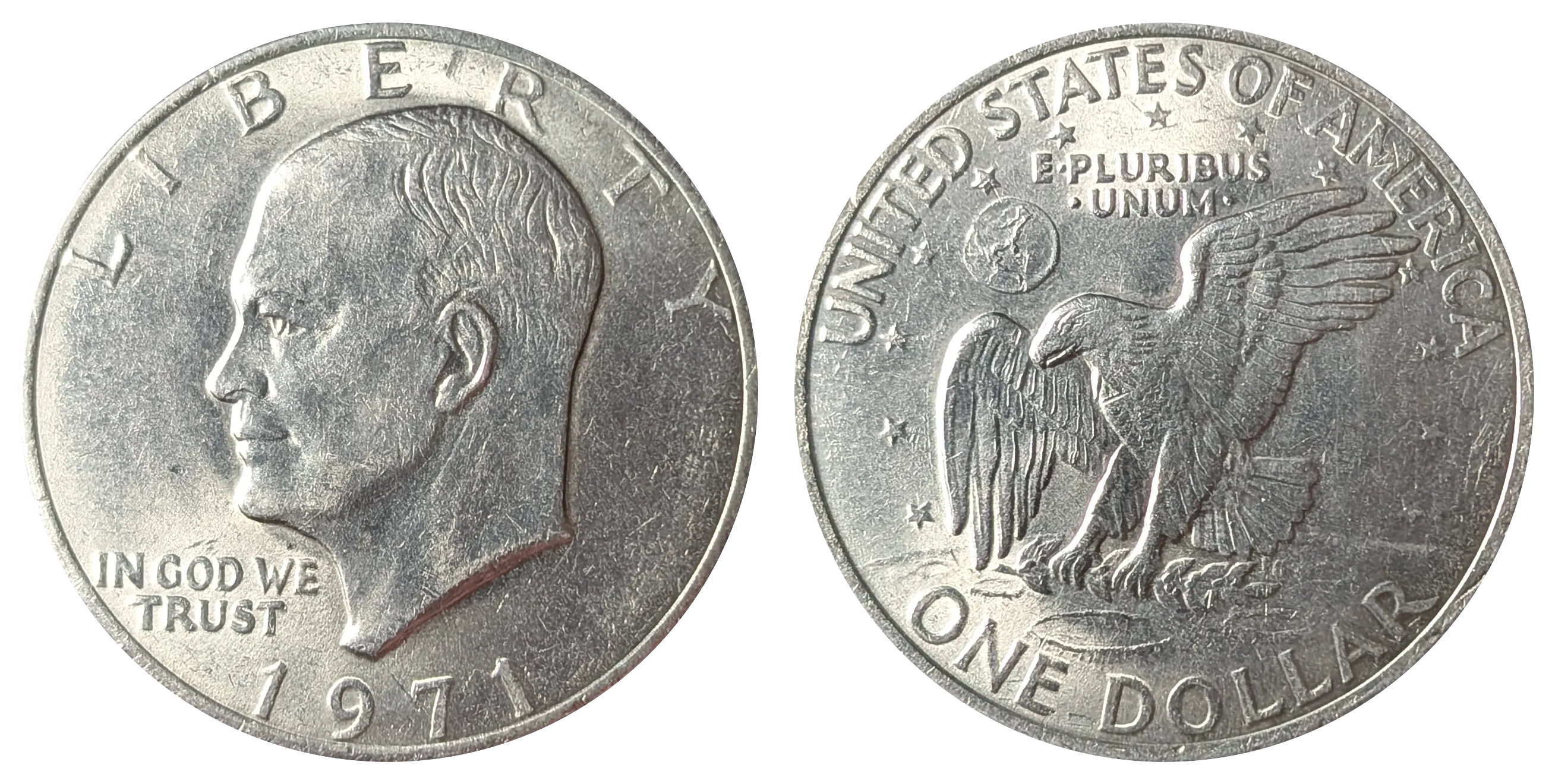
D/ Obverse
LIBERTY / IN GOD WE TRUST / 1971
Bust of Dwight D. Eisenhower facing left.
R/ Reverse
UNITED STATES OF AMERICA / E·PLURIBUS ·UNUM· / ONE DOLLAR
Eagle landing on the Moon with an olive branch in its talons; the Earth in the background.
The reverse of this dollar coin shows the Apollo 11 Moon landing. An eagle alights on the Moon with an olive branch in its talons, and the Earth hangs in the distance. On the obverse is Dwight D. Eisenhower, the president who signed the act that created NASA. The coin is dated 1971, the first year of issue, and was struck while the Apollo programme was still under way.
The obverse reads “LIBERTY”, with the motto “IN GOD WE TRUST” and the date. Around the eagle on the reverse run “UNITED STATES OF AMERICA”, “ONE DOLLAR” and “E PLURIBUS UNUM”, Latin for “out of many, one”.
On 4 October 1957, the Soviet Union launched Sputnik, the first artificial satellite, and space became a new front in the Cold War. The following year, Eisenhower signed the act that created NASA, the American civilian space agency. When Yuri Gagarin became the first human in space on 12 April 1961, the United States was still behind. A few weeks later, on 25 May, President John F. Kennedy went before Congress. He asked the nation to commit to landing a man on the Moon and returning him safely to Earth before the decade was out.
The Apollo programme reached that goal in July 1969. Apollo 11 lifted off on 16 July with Neil Armstrong, Buzz Aldrin and Michael Collins aboard. On 20 July, Armstrong and Aldrin landed the lunar module Eagle in the Sea of Tranquility. Collins stayed in lunar orbit aboard the command module Columbia. Hundreds of millions of people watched on television as Armstrong stepped onto the surface: “That’s one small step for man, one giant leap for mankind.” A plaque left on the lander read: “We came in peace for all mankind.” Five more crews landed by December 1972, when Apollo 17 closed the programme. In all, twelve men walked on the Moon.
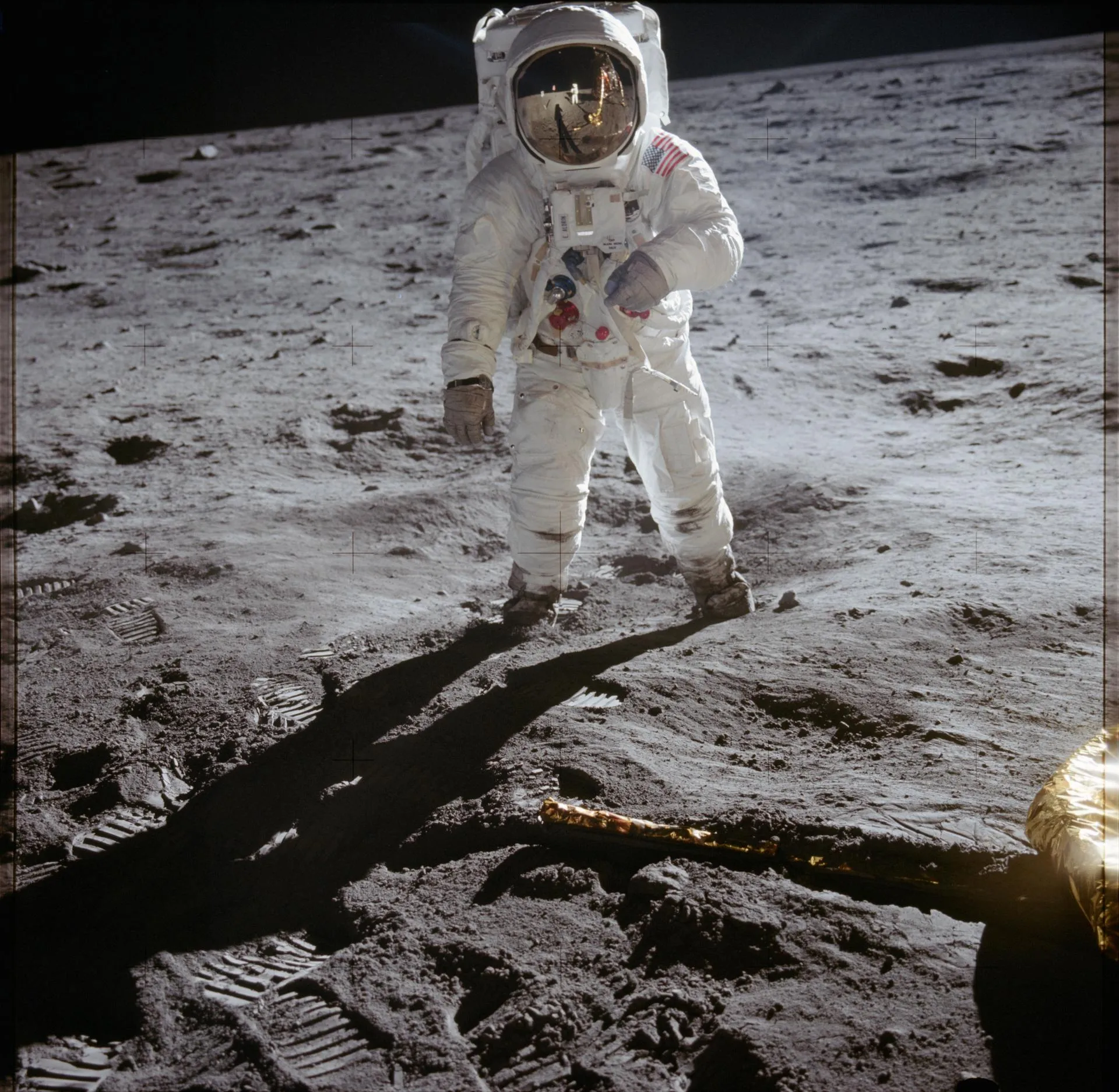
Buzz Aldrin on the Moon, photographed by Neil Armstrong. Photo: NASA, public domain.
Eisenhower did not live to see the landing: he died in March 1969. At the end of 1970, Congress authorised a new dollar coin bearing his portrait, the first circulating dollar coin since 1935. The law asked for a reverse “emblematic of the symbolic eagle of Apollo 11 landing on the moon”. Chief Engraver Frank Gasparro adapted the mission’s insignia, which the crew had designed themselves. It showed an eagle descending onto the lunar surface with an olive branch, a sign of peaceful intent. The coin thus paired the president who had signed the law creating NASA with the agency’s landing on the Moon.