1922 AD
Fascist Italy
- Denomination
- 2 lire
- Authority
- Kingdom of Italy
- Date
- 1923 AD
- Mint
- Rome
- Date on coin
- 1923
- Mint mark
- R
- Material
- Nickel
- Weight
- 10 g
- Diameter
- 29 mm
- Thickness
- 2 mm
- Die axis
- 6 h
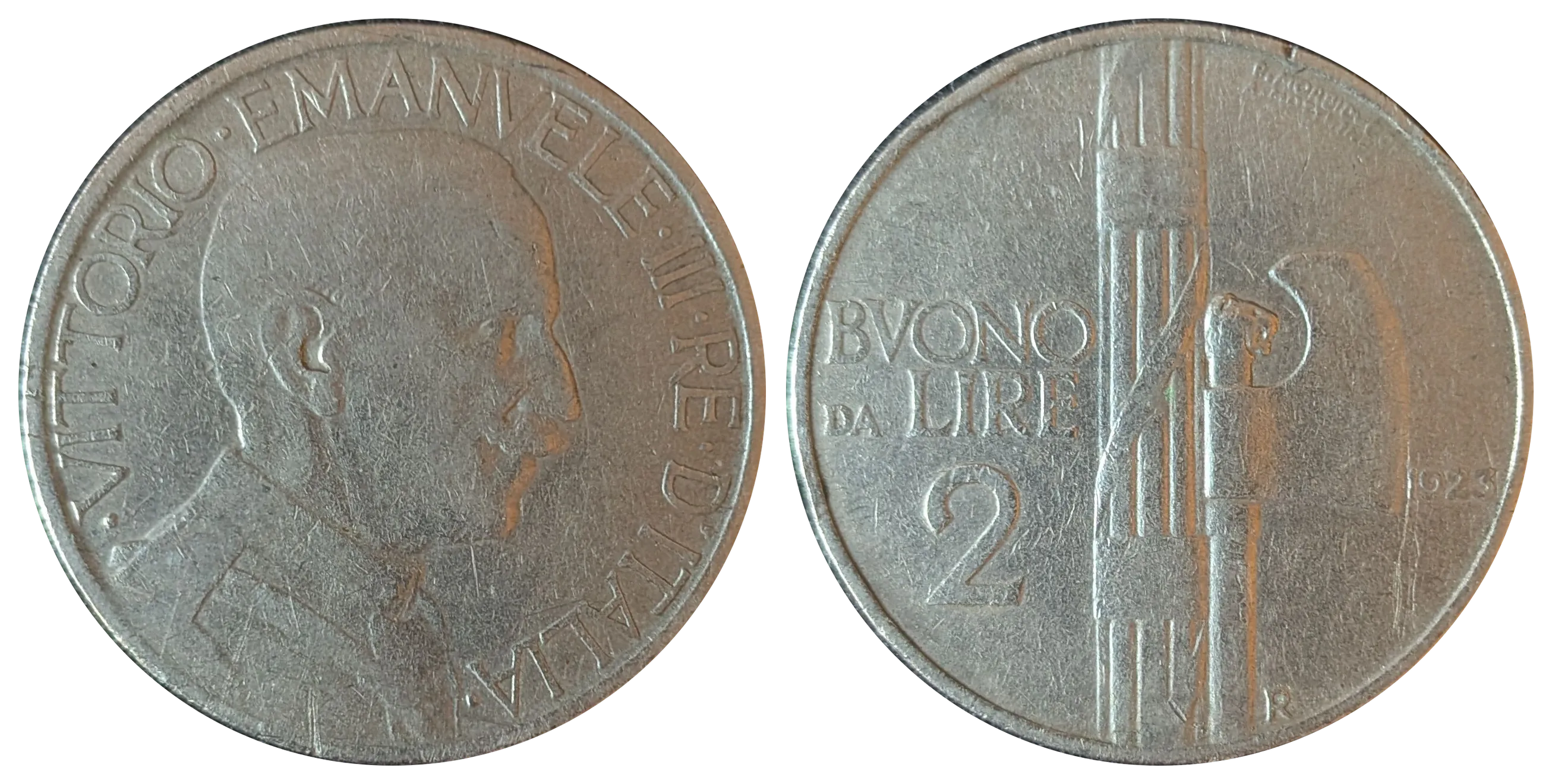
D/ Obverse
·VITTORIO·EMANVELE·III·RE·D'ITALIA·
Bust of Victor Emmanuel III right, in uniform.
R/ Reverse
BVONO DA LIRE 2 / 1923 / R
Upright fasces with the axe to the right, decorated with a lion's head; the value to the left. Signatures P. MORBIDUCCI and A. MOTTI INC. at upper right.
Ref. KM 63; Pagani 741; Gigante 105
This 2-lire coin is dated 1923. It was struck a few months after the March on Rome, which brought Benito Mussolini to power in October 1922. It is among the first coins of the Kingdom of Italy to carry the fasces, the symbol of his movement, and puts it at the centre of the reverse.
The obverse reads “VITTORIO EMANVELE III RE D’ITALIA” (“Victor Emmanuel III, King of Italy”), with V for U as in Latin inscriptions. The king appears as a half-length bust, in uniform. Italy remained a monarchy throughout Fascism, and the king stayed head of state.
On the reverse, a large fasces fills the centre. It is a bundle of rods tied around an axe. In ancient Rome, attendants called lictors carried it before magistrates, as a sign of their power to punish. Here the axe is decorated with a lion’s head. Mussolini’s movement, founded in 1919 as the Fasci di combattimento (“combat leagues”), took its name from the Italian word fascio and had adopted this symbol. The sculptor Publio Morbiducci designed the reverse and Attilio Motti engraved it; their signatures are at upper right. At lower right, the “R” marks the Rome mint.
The words “BVONO DA LIRE 2” (“voucher for 2 lire”) explain the coin’s name. During and after the First World War, the state had printed paper “cash vouchers” (buoni di cassa) for 1 and 2 lire. A law of February 1921, before Fascism, decided to replace them with pieces of pure nickel. On 21 January 1923, a decree signed by Mussolini authorised 100 million lire of these metal vouchers, which kept the old name.
The March on Rome was announced in Naples, at the Fascist rally of 24 October 1922. From 27 October, Fascist squads attacked prefectures and headed for Rome. On the morning of the 28th, the king refused to sign the state of siege put to him by the prime minister, Luigi Facta. On the 29th he asked Mussolini to form a government, which was sworn in on 31 October.
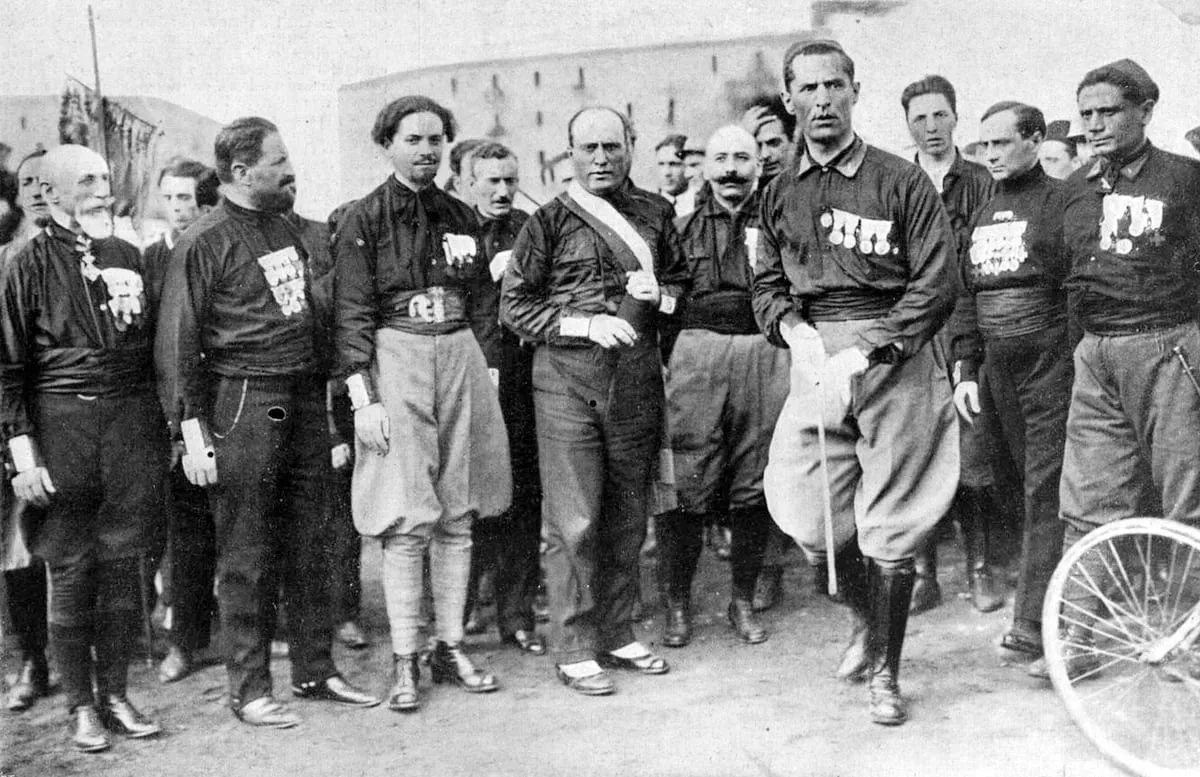
Mussolini (centre, with the sash) among the quadrumvirs, the four leaders of the March on Rome, in Naples on 24 October 1922. Photo: unknown author, from L’Illustrazione Italiana, public domain.

The government became a dictatorship. On 10 June 1924, a group of Fascists murdered the Socialist deputy Giacomo Matteotti. On 3 January 1925, Mussolini told the Chamber of Deputies that he took responsibility for everything Fascism had done. Between 1925 and 1927, the so-called “most Fascist laws” built the regime, and at the end of 1926 the non-Fascist parties were dissolved. In December 1926, a decree made the fasces the emblem of the state.
These coins circulated until the war. Italy entered the Second World War on 10 June 1940. Two weeks later, a decree withdrew the nickel 1- and 2-lire coins: they stopped being legal tender on 31 July 1940, and hoarding them could bring up to five years in prison. On 25 July 1943, the Fascist Grand Council voted against Mussolini, and the king dismissed him and had him arrested. Three years later, in the referendum of 2 June 1946, Italians chose a republic.
Sources
- Numista: 2 lire Victor Emmanuel III (Buono), 1923-1935
- Law of 17 February 1921, no. 141: replacing the cash vouchers with nickel pieces (in Italian)
- Royal decree-law of 21 January 1923, no. 215: nickel 1 and 2 lire vouchers (in Italian)
- Gazzetta Ufficiale, 2 October 1923, no. 231: end of the paper vouchers (in Italian)
- Gazzetta Ufficiale, 15 December 1926, no. 288: the fasces as state emblem (in Italian)
- Gazzetta Ufficiale, 8 July 1940, no. 158: withdrawal of the nickel coins (in Italian)
- Treccani, Dizionario di Storia: marcia su Roma (in Italian)
- Treccani, Dizionario Biografico: Benito Mussolini, by E. Gentile (in Italian)
- Italian Chamber of Deputies: first Mussolini government (in Italian)
- Italian Chamber of Deputies: the 1946 referendum (in Italian)